

The struggle of the Iberian Peninsula
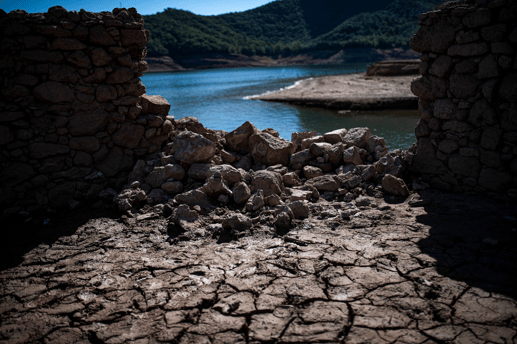
Since April 2023, in the Sado river basin in the Alentejo (Portugal) and the Sau basin in Catalonia (Spain), a long-term drought has been hitting the region with no mercy. The water level has dropped to below 10% of the reservoir's capacity, noting that this part of Catalonia has not seen sustained rain in two-and-a-half years. According to Miguel Manzanares, a Barcelona-based meteorologist who studies extreme weather events on the European continent, regions like Catalonia are particularly exposed to those issues.
As a result, Spain has to deal with a severe water shortage affecting people’s lives, as emerging measures have been taken to regulate the situation since last August’s water restrictions. “The problem is that the underground water tables are running dry now, so people with their own supplies from wells will soon be affected,” said Pep Morató, council spokesman in L’Espluga de Francoli, in Euronews.
In concrete terms, in L’Espluga de Francolí, a village in the province of Tarragona and autonomous community of Catalonia, the taps are turned off at night until the morning, from 10pm to 7am, making it impossible to wash the dishes or have a shower. As many Spaniards eat at a late hour, this affects their way of living.
People are afraid of the effect of this crisis on their land that is already showing fallout, and will most likely worsen in the future. It is also important to mention the agricultural sector that is one of the most challenged. Spain’s long-term drought is causing “irreversible losses” to more than 3.5 million hectares of crops, states the Coordinator of Farmers’ and Ranchers’ Organizations (COAG in its Spanish acronym) in their new report. Meanwhile, Javier Fatas, head of water and environment for COAG, confirmed that “This has been the most expensive planting season on record, and with harvests ruined or reduced by 60 to 80%, there will be many farms that will have a very tough time surviving if they don’t receive an injection of capital”.
Given the importance of the sector, the Minister of agriculture, Luis Planas, says : “The main objective is to secure the productive continuity of our primary sector – of our crop and livestock farmers – so that they can produce food, which is a fundamental element when it comes to providing for our citizens, but which is also very important when it comes to food prices.”
Greece and Italy are burning
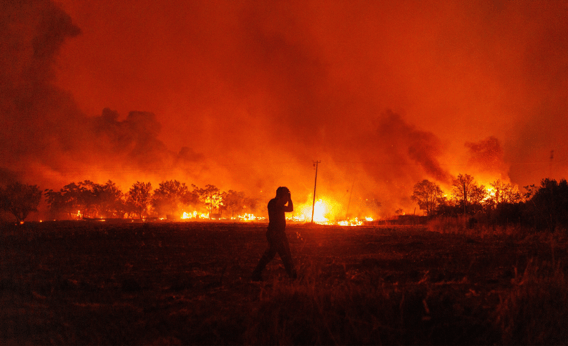
Another example of the Mediterranean region is the burdensome summertime for the neighboring countries of Greece and Italy, which suffered from uncontrollable wildfires.
In Greece, during the months of July and August 2023 occurred simultaneously about 67 forest fires. According to the National Observatory of Forest Fires (NOFFi), 1.2 million acres were burnt as a result of the August fires only.
More specifically, on the Rhodes Islands, in July 2023, at the peak of the tourist season, around 10% of the island was completely burnt in about 10 days of fires; and a record-breaking evacuation of 30.000 people from the land, according to Konstantia Dimoglidou, a Greek police spokeswoman. As an important touristic hub for the island, it is unneglectable to mention the consequences that the fires had on the locals as the tourist season ended earlier than expected.
In the meantime, on the Corfu Island, people had to deal with the outbreak of new wildfires. On the southwest Greek island, more than 19,000 citizens were evacuated which, once again represents one of the largest evacuation in the island's history, as the mayor describes it: “a nightmare for all of us".
In Italy, in August 2023, it was Sicily that issued a state of emergency due to wildfires described by Sicilian President Renato Schifani as "one of the most difficult day in decades". A major tragedy for Sicily that resulted in the burning of many forests, villages, heritage sites; and even the death of three people found in their home while the temperature reached 46.7 degrees C in Catania, and the wildfires were spreading rapidly due to strong winds. About the historical sites, nearly 3 months later the many efforts to restore the damages done, even if hardly recoverable, Luigi Biondo, director of the archaeological park of the destroyed site of Segesta, expressed: "This is a passage in my life that is very sad, very complicated, because a piece of my life was burnt. I feel like a hero of a Greek tragedy, wounded but still standing".
Besides these tragedies, it is necessary to mention that neither country had time to recover from the sudden environmental disasters that occurred. Greece, more specifically Alexandroupolis, suffered from 16 days long wildfires; and the city of Volos endured disastrous floods. The city’s mayor Achilleas Beos described his land’s despair saying that“all of Volos has turned into a lake. People’s lives are in danger. Even I remained trapped, and 80% of the city is without power. I don’t know where God found so much water. It is like the story of Noah’s Ark”.
Also, in August 2023, in the northern part of Italy, during the wildfires in Sicily, storms were hitting the region so intensely that it resulted in the death of two people. Besides the undeniable challenge they had to face, the Italian inhabitants did not even get the chance to recover from May 2023’s Rome worst floods recorded in 100 years. A cause for these floods occurring in the northern and eastern regions of Emilia Romagna and Le Marche is the torrential rains following months of drought. This phenomenon has killed over 14 people and left an estimated 20,000 citizens homeless.
What should we keep from that?
Amongst the non-exhaustive list of environmental disasters that are currently affecting our planet, one can agree that the world is changing, leading to more and more suffering.
Even if for many years we tried to ignore the situation, Mother Nature is now responding for the damage we caused. We have to pay attention to what is happening around the world and inform ourselves, hoping that our fellow human beings feel our solidarity.
That is why, when it comes to natural catastrophes, we must keep in mind one question:
"What can I do to help?"
By Dimou Marianthi
To go further on our December file dedicated to ecology, you can read our International Relations and Society sections’ articles on our blog.
Follow MINERVIEWS
...